
Sofa Colour Combinations: What Looks Great in the Showroom vs What Survives Your Living Room
For most Bangalore homes, mid-tone neutrals with some fabric texture — warm greys, taupe, greige, muted browns — offer the most practical long-term balance between hiding everyday dust and not showing every stain.
Hemanth Kumar · Founder & Lead Designer · Published · Updated
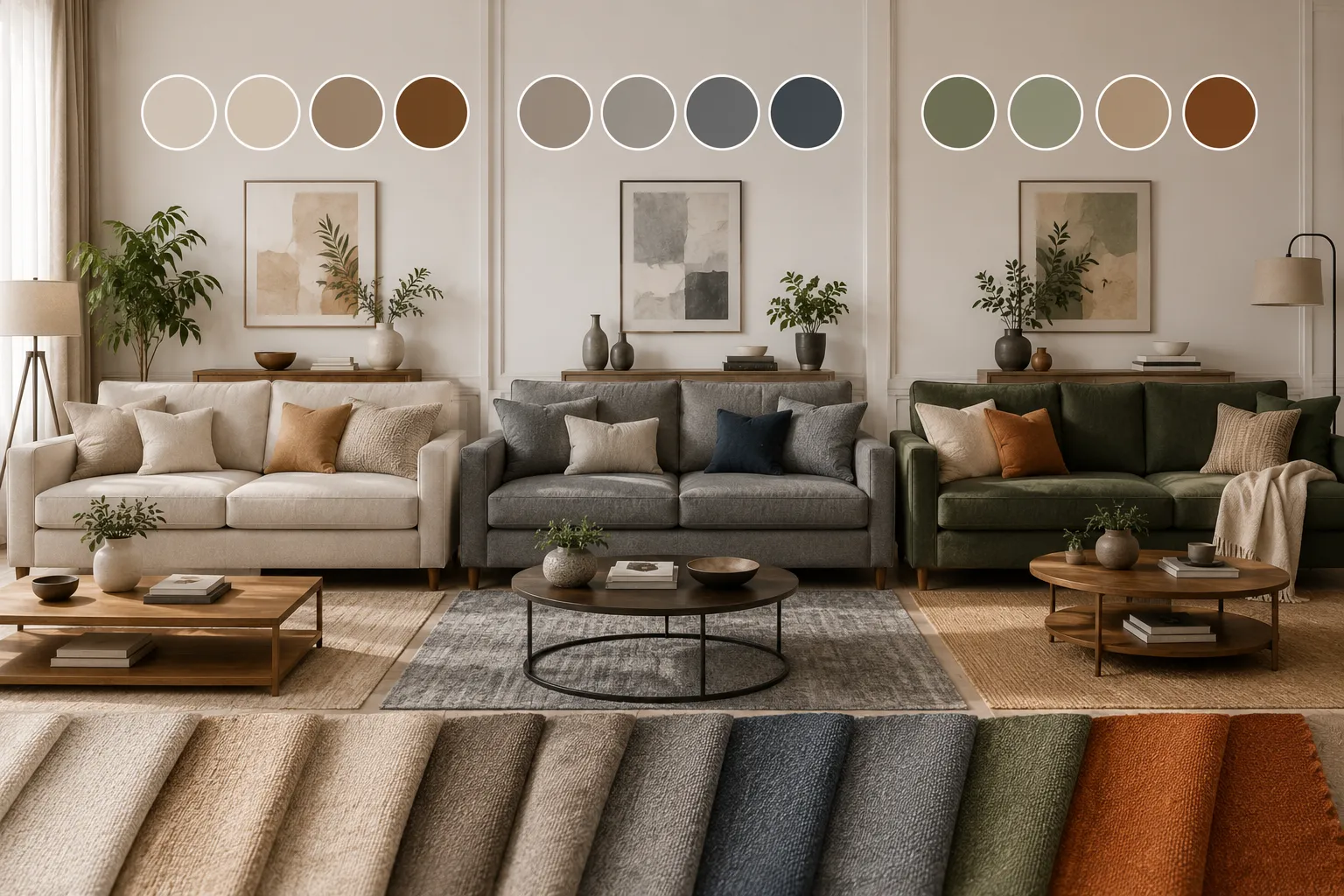
A sofa that looked flawless in the showroom photo often looks different eight months later — a faint grey film across the arms from everyday dust, a water ring near the seat, cushions that show every sit-mark by evening. None of that is a manufacturing fault. It's usually a colour decision made without accounting for how the sofa would actually be used, cleaned and lived on.
Key Takeaways
- Dust visibility, stain visibility and wear visibility are three separate problems, not one — a colour that hides dust well can still show a coffee stain clearly, and vice versa.
- Mid-tone, textured upholstery generally outperforms both extremes (pure white and true black) for daily-use households because it doesn't rely on colour alone to camouflage everyday marks.
- Fabric weave changes how a colour behaves as much as the colour itself — a smooth, glossy weave shows lint and pet hair far more than a textured one in the same shade.
- Compact Bangalore apartments generally read better in lighter, warmer neutrals, while larger villas and open-plan living rooms can carry deeper, richer tones without feeling closed in.
- A trending colour isn't automatically a good long-term choice — some of the most "current" sofa colours right now are strong personality colours that work brilliantly for a few years and then date faster than a neutral would.
- Custom upholstery removes the biggest limitation of ready-made sofas: instead of picking the closest match from a fixed catalogue, you choose the colour and fabric to suit your actual wall, floor, and lighting.
Recommended: Fabric vs. Leather Sofa Which Actually Survives
How to Choose a Sofa Colour for a Bangalore Home
The honest starting point isn't "which colour do I like" — it's a handful of practical factors that decide how that colour will actually behave in your home:
- Natural light: A north-facing room and a west-facing room can make the same fabric swatch appear as two different colours by late afternoon.
- Room size: Smaller rooms generally read as more open with lighter, cooler-toned neutrals; larger rooms have the visual space to carry deeper colours without feeling heavy.
- Flooring and walls: A sofa colour that contrasts gently with the floor tends to look intentional; one that matches too closely can flatten the whole room.
- Cleaning frequency and household use: A home with young children, pets, or frequent guests has genuinely different practical needs than a low-traffic formal sitting room.
- How often do you plan to redecorate? A bold, current colour makes sense if you're comfortable reupholstering or replacing in a few years; a safer neutral makes more sense as a longer-term piece.
There's rarely one universal "best" answer here — the honest version of this advice is trade-offs, not a single winning colour.
Best Sofa Colours for Long-Term Use
Some colours genuinely hold up better over years of daily use, not because they're fashionable, but because they balance visibility of dust, stains and wear more evenly than the extremes.
Colour | Dust Visibility | Stain Visibility | Wear Visibility | Bangalore Suitability | Best Room Type | Timeless or Trend-Led |
Beige | Low-Medium | Medium | Low | High | Any | Timeless |
Taupe / Greige | Low | Medium | Low | High | Any | Timeless |
Warm grey | Low-Medium | Low-Medium | Low | High | Any | Timeless |
Charcoal | Medium (shows dust/lint) | Low | Low | Medium-High | Larger rooms | Timeless |
Brown | Low | Low-Medium | Low | High | Any | Timeless |
Terracotta / Rust | Medium | Medium | Medium | Medium | Larger, well-lit rooms | Trend-led |
Olive / Sage | Low-Medium | Medium | Low-Medium | Medium | Larger, earthy interiors | Trend-led |
Muted blue | Medium | Medium | Medium | Medium | Bright rooms | Trend-led |
Cream / Off-white | High | High | Medium | Low-Medium | Low-traffic, formal rooms | Timeless but high-maintenance |
Beige, taupe, warm grey and brown consistently score well across all three visibility categories, which is why they show up so often in practical, non-showroom recommendations — not because they're the most exciting choice, but because they ask the least of daily maintenance.
Which Sofa Colours Hide Dust and Daily Wear Best?
Colour alone doesn't determine how visible dust and wear will be — the fabric's texture and weave matter just as much. A tightly woven, slightly textured fabric in a mid-tone shade breaks up light reflection in a way that smooth or glossy fabrics don't, which is why two sofas in the "same" grey can look completely different after a few months of use.
Very dark colours are often assumed to hide everything, but smooth black or deep charcoal upholstery actually shows dust, lint and pet hair more visibly than people expect, simply because of the contrast. Very pale colours show spills and marks fastest, for the opposite reason — there's no tonal camouflage to soften a stain against.
Mid-tone, textured upholstery tends to provide the most practical middle ground: dark enough to camouflage dust, light enough that stains aren't the first thing anyone notices, and textured enough to hide day-to-day surface wear.
Which Sofa Colours Show Dust, Stains and Wear the Most?
- White and cream: Show spills, ink, food stains and general contact marks the fastest, particularly on arms and seat edges — the most demanding option for a high-use family sofa.
- Very pale beige: A step more forgiving than white, but still shows stains noticeably faster than a mid-tone.
- Black and very dark charcoal: Show dust, lint and pet hair more visibly than most buyers anticipate, especially in smooth or glossy fabric finishes.
- Glossy, smooth fabrics in any colour: Reflect light in a way that highlights surface wear, fingerprints and everyday contact marks faster than textured weaves.
None of this means these colours should be avoided outright — it means they generally work better in lower-traffic settings or with a genuinely committed cleaning routine, rather than as the default choice for a daily family sofa.
Best Sofa Colour Combination for a Sofa Set
A single-colour sofa set is the safer, lower-maintenance choice, but a well-planned sofa colour combination — sofa in one tone, accent chair or cushions in a complementary one — can make a room feel considerably more designed without adding real upkeep.
Combination | Interior Style | Room Type | Maintenance | Complementary Wall/Floor |
Beige + brown | Warm, classic | Any | Low | Warm white walls, wood flooring |
Cream + tan | Soft, formal | Low-traffic living rooms | Medium | Warm white or pale walls |
Grey + charcoal | Modern, minimal | Any | Low | Light grey walls, light or dark flooring |
Beige + olive | Earthy, contemporary | Larger rooms | Medium | Warm white or terracotta accent wall |
Warm grey + muted blue | Bright, contemporary | Well-lit rooms | Medium | Light walls, cool-toned flooring |
Neutral sofa + accent chair | Flexible, evolving décor | Any | Low (sofa) / varies (accent) | Any — accent piece carries the personality |
The safest long-term version of this idea is a neutral sofa colour combination for the main sofa set, with the more expressive colour choice placed on a smaller, easier-to-replace piece — an accent chair or cushions — rather than the full sofa itself.
Best Sofa Colors for Living Room Spaces
Compact apartments: Lighter, warmer neutrals with subtle texture tend to keep a small living room feeling open, since pale tones reflect more available light without the high-maintenance cost of true white.
Larger living rooms: Richer, deeper colours — charcoal, brown, terracotta — have enough visual room to work without making the space feel smaller, and can actually add warmth to an otherwise large, echoey open-plan area.
Bright, sun-facing rooms: Strong natural light can wash out pale colours and intensify warm tones considerably, so it's worth viewing any shortlisted swatch in the room's actual midday light before deciding.
Low-light rooms: Cooler or very dark tones can make an already dim room feel heavier; warmer neutrals generally read better when natural light is limited for most of the day.
Living Room Sofa Colour Combinations by Interior Style
- Modern minimalist: Grey and charcoal, kept to two tones maximum, with no more than one accent colour.
- Warm contemporary: Beige or taupe sofa with brown or rust accents — comfortable, not stark.
- Earthy and natural: Olive, beige and terracotta layered together, generally suited to larger rooms with natural materials like cane or wood.
- Luxury-leaning: Deep, saturated single-colour sofas (emerald, deep brown, charcoal) rather than busy combinations — luxury reads through restraint more than variety.
- Family-friendly: Mid-tone neutral sofa with a patterned or contrasting accent chair that hides marks better than the main seating piece.
- Bold accent interiors: Neutral sofa base with one genuinely bold element — a single accent chair or cushion set — rather than colour on every piece.
Latest Sofa Colours — What's Trending and What Will Age Well?
Current interior design direction leans toward warmer, earthier tones — terracotta, olive, muted rust — alongside a continued preference for warm greys over cooler ones. These aren't unfounded trends, but it's worth separating two different questions before choosing based on them.
Trend-led colours are ones that feel current right now specifically because they're less common — that novelty is also what makes them date faster. Olive, rust and strong muted blues fall into this category: genuinely attractive, but more likely to feel dated in five to seven years than a neutral would.
Long-term colours — beige, taupe, warm grey, brown — don't chase a specific design moment, which is exactly why they've stayed in steady demand for years rather than trending in and out. If the sofa is a piece you expect to keep for a decade, this category is the safer bet; if you're comfortable reupholstering or replacing sooner, a trend-led colour is a reasonable, more expressive choice.
Sofa Colour Ideas by Home Type
Compact apartments in HSR Layout and Koramangala usually read better in lighter, warmer neutrals, which keep a small living room visually open. Larger homes around Whitefield and Sarjapur Road often have more floor space and natural light, so richer tones like brown, charcoal or terracotta work without closing the room in. Open-plan villas have enough breathing room for a genuine sofa colour combination, a sofa plus a contrasting accent chair, rather than staying strictly neutral for proportion.
Does Fabric Change How a Sofa Colour Looks?
Significantly. The same colour name can look almost unrecognisable depending on the fabric:
- Velvet deepens colour and adds visible sheen that shifts with light direction, making the same shade look richer than it would in a matte fabric.
- Linen-look weaves soften a colour and read more casual, but show creasing and light wear more visibly than a tighter weave.
- Textured fabrics break up light reflection, which is exactly why they tend to hide dust and daily wear better than smooth finishes in the same colour.
- Smooth, glossy fabrics reflect more light and show fingerprints, lint and surface marks faster, regardless of how dark or light the colour is.
This is also why judging a colour from a website photo or showroom sample under studio lighting is unreliable — the same swatch can look meaningfully different once it's viewed in your own room's morning and evening light.
Common Mistakes People Make Choosing Sofa Colours
- Deciding from a catalogue photo alone, without checking how the colour reads under the room's actual lighting conditions.
- Choosing pure white for a high-use family sofa without weighing the realistic maintenance commitment that colour demands.
- Assuming black hides everything — smooth black upholstery shows dust and lint more than most buyers expect.
- Matching the sofa exactly to walls or flooring, which often flattens the room rather than making it look coordinated.
- Choosing a colour purely because it's currently trending, without considering whether it's meant to be a five-year piece or a ten-year one.
- Ignoring fabric texture entirely, and judging maintenance based on colour alone.
- Deciding on a combination before checking the room's existing palette — wall colour and flooring should generally come first, not last.
Expert Tips From Furniture Designers
Designer's recommendation: View upholstery samples in both morning and evening light before deciding — the same swatch can look noticeably different depending on when you view it.
Furniture-maker's insight: Judge fabric texture before judging colour alone; a textured mid-tone will usually outperform a smooth version of the same shade for everyday dust visibility.
Best for compact apartments: Lean toward lighter or mid-tone shades with visible texture rather than defaulting to plain white for the sake of brightness.
Best for high-use family rooms: Practical mid-tone colours generally balance stain visibility and everyday dust better than either extreme.
Best for a sofa colour combination: Keep the main sofa neutral and place the more expressive colour on a smaller, easier-to-replace piece.
Custom Sofa Colour vs Ready-Made Colour Options
A ready-made sofa's colour range is fixed by whatever the manufacturer stocked that season — which means the closest match to your room is often still a compromise, not an exact fit. If your wall colour sits slightly warmer or cooler than the catalogue swatch anticipated, there's no way to adjust it after the fact.
A custom sofa removes that constraint directly. Upholstery colour, fabric texture, piping and even accent-cushion combinations can be chosen together, against your actual wall and floor colours, rather than picked from a fixed range and hoped to work. It doesn't mean unlimited colour matching or a guaranteed identical result to a paint swatch — fabric and paint behave differently under the same light — but it does mean the sofa is built to complement the room you actually have, instead of the room being arranged around whatever colour happened to be in stock.
How AAF Helps Customers Choose the Right Sofa Colour
There's no single sofa colour combination that works for every Bangalore home — the right one depends on your room's light, your flooring, your household, and how much maintenance you're genuinely willing to keep up with. Start with a practical mid-tone neutral if you want the safest long-term choice, or build the combination around a smaller accent piece if you'd rather keep things flexible. Either way, judging an actual fabric sample in your own room's light is a more reliable step than any general list, including this one.
The sequence matters more than the final swatch. AAF's design team starts by understanding the room — dimensions, existing wall and floor colours, and how much natural light it gets through the day — before narrowing down fabric and colour options. Usage and maintenance expectations come next: a home with children and pets genuinely needs a different recommendation than a low-traffic formal room, and that's worth discussing honestly before committing to a colour. From there, upholstery samples are reviewed against the actual room, not a showroom light, and the final sofa colour combination is built around what the space needs rather than a fixed catalogue range.
If you're weighing a sofa colour or combination and aren't sure what will actually hold up in your home, AAF's team can walk through fabric options and colour pairings against your own walls and lighting before anything is built.
Frequently asked questions
What is the best sofa colour for a living room?
There's no single best colour for every living room — it depends on room size, natural light and household use. Mid-tone neutrals like beige, taupe, and warm grey generally offer the most practical balance for most homes. Current design direction leans toward warmer, earthier tones like terracotta and olive, alongside continued demand for warm greys. These trend-led colours can date faster than neutrals, so they suit buyers comfortable reupholstering sooner.
Which sofa colour hides dust best?
Mid-tone, textured upholstery generally hides everyday dust better than either very dark or very pale colours, since the texture breaks up light reflection that would otherwise highlight dust particles.
What sofa colour is easiest to maintain?
Mid-tone neutrals with some fabric texture tend to be the easiest to maintain day-to-day, since they balance dust visibility and stain visibility better than white or true black.
Is beige a good sofa colour?
Yes, generally — beige scores well across dust, stain and wear visibility, and works in most Bangalore homes regardless of room size or lighting, which is why it remains a consistently practical choice.
Which sofa colour combination is best for a living room?
A neutral sofa base — beige, grey or taupe — paired with a contrasting accent chair or cushions generally works best, since it adds visual interest without committing the full sofa to a bolder colour.
How do I choose a sofa colour that matches my walls?
A gentle contrast — rather than an exact match — usually looks more intentional. Viewing fabric samples against the actual wall colour in your own lighting is more reliable than matching from memory or a photo.
Tags:Sofas
Keep reading
Materials
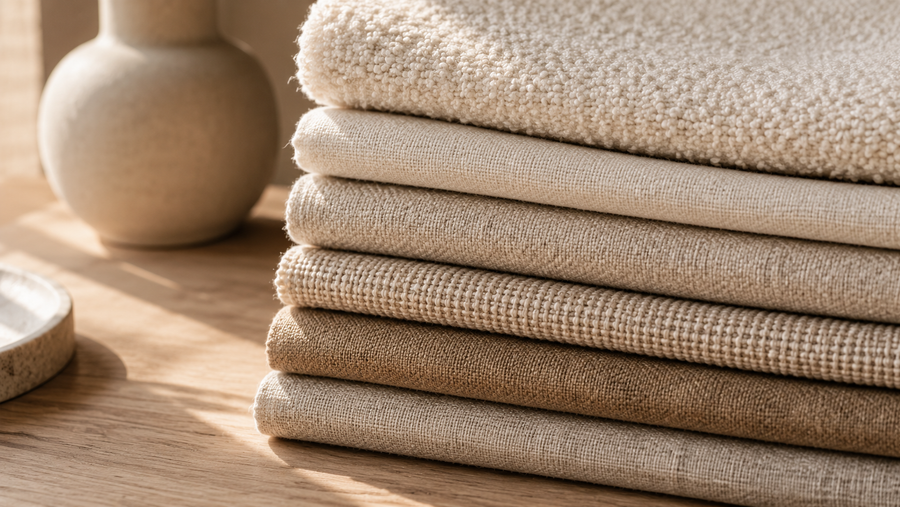
How to choose a sofa fabric that survives real life
The right sofa fabric balances three things: how it feels, how it looks after two years, and how much care you will honestly give it. Here is how we help clients choose.
Meera Nair ·
Guides
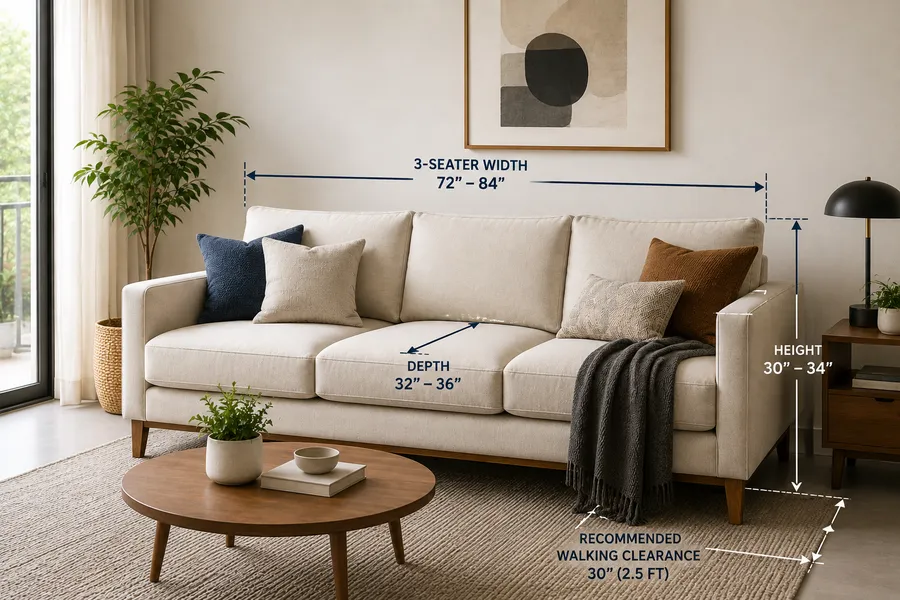
Sofa Dimensions Guide for Bangalore Living Rooms
A 3-seater runs 6 to 7 feet wide on paper, but that number means nothing until it meets your actual wall, doorway and walkway. The measurements, conversions, and clearances that decide whether a sofa really fits.
Meera Nair ·
Guides
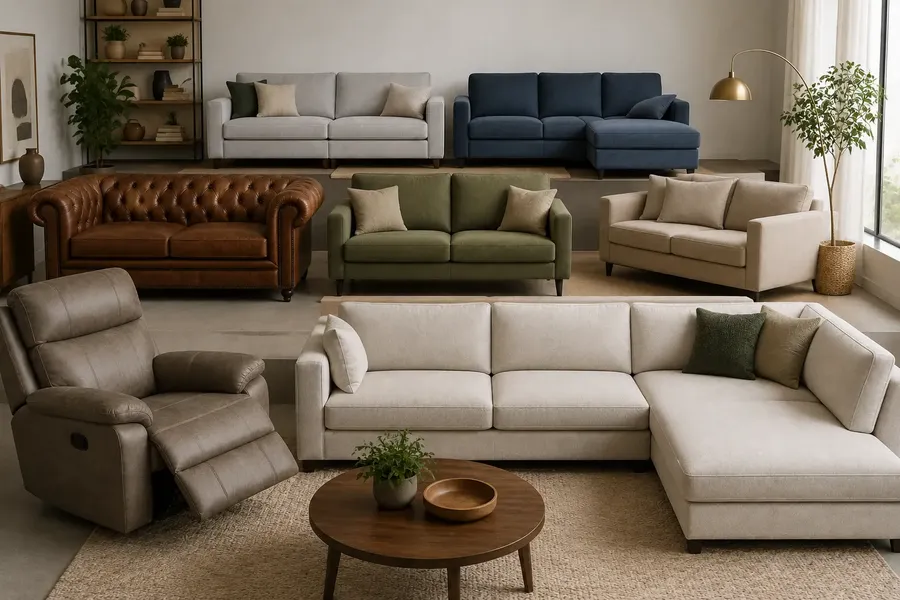
Types of Sofas: A Complete Guide to Choosing the Right One
Most sofa shopping goes wrong before it even starts — people pick a style before checking whether it fits the room. This guide breaks down every major sofa type, what each is actually built for, and how to match one to your home instead of the other way around.
Meera Nair ·
Thinking about a custom piece?
We design and craft furniture around your space, style and story.