
Types of Sofas: A Complete Guide to Choosing the Right One
Most sofa shopping goes wrong before it even starts — people pick a style before checking whether it fits the room. This guide breaks down every major sofa type, what each is actually built for, and how to match one to your home instead of the other way around.
Meera Nair · Materials & Finishes Specialist · Published · Updated
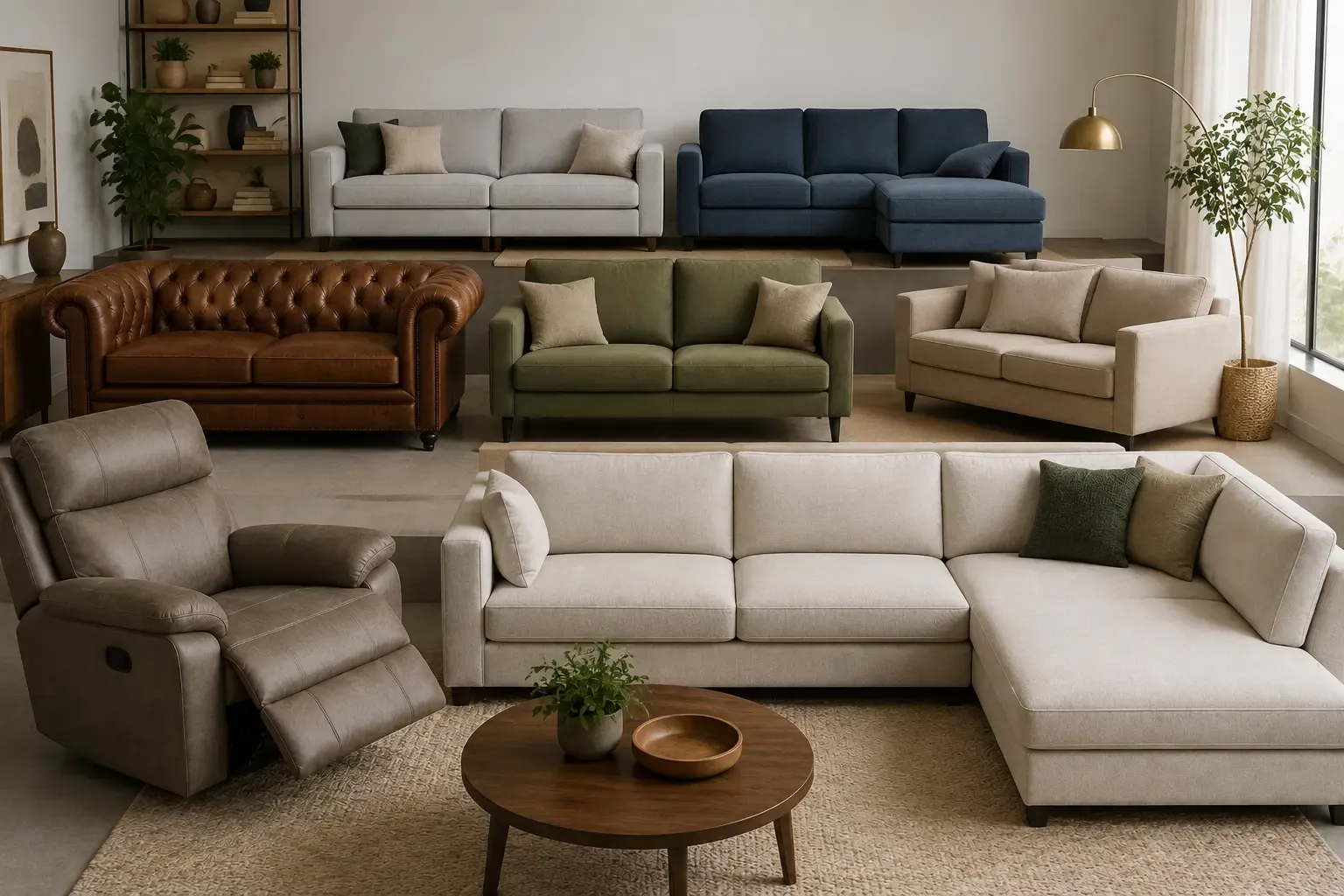
Ask ten people to describe "a sofa," and you'll get ten different pictures in their heads — a Chesterfield, an L-shaped sectional, a compact loveseat, a sofa cum bed. That's the first problem most buyers run into before they've even started shopping: the types of sofa available today aren't variations on one shape; they're genuinely different pieces of furniture built for different rooms, habits, and households.
Quick answer: The main types of sofas are the 3-seater (standard straight sofa), L-shaped/sectional, loveseat, Chesterfield, recliner, sofa cum bed, modular sofa, chaise lounge, tuxedo sofa, and settee. Straight 3-seaters and loveseats suit compact apartments; L-shaped sectionals and modular sofas suit open-plan villas and larger living rooms; recliners and sofa cum beds serve specific functional needs rather than general seating.
Key Takeaways
- The right sofa type depends on room shape more than personal taste — an L-shaped sectional that looks stunning in a photo can block circulation in a room without a natural corner to anchor it.
- Sofa names aren't standardized across brands, which is why the same design gets called a "sectional" in one showroom and a "corner sofa" in another. Knowing the actual shape and function matters more than the label.
- Function should drive the choice before style does. A recliner solves a comfort need, a sofa cum bed solves a space need, a modular sofa solves a flexibility need — style is the layer on top, not the starting point.
- Bangalore homes span a wide range of layouts, from compact HSR Layout apartments to open-plan Sarjapur villas, and the sofa type that works well in one rarely works as well in the other.
- Custom-built sofas remove the compromise between the type you want and the type that technically fits, since dimensions and configuration can be adjusted to the room instead of the room being arranged around a fixed showroom size.
What Is a Sofa, Really?
A sofa is upholstered seating designed for two or more people, built around a wooden or metal frame, filled with cushioning material, and finished with fabric, leather, or leatherette upholstery. That's the technical definition — but it undersells how much the category has expanded. What started as a single fixed shape has split into distinct sofa types built for entirely different uses: seating for conversation, seating that converts into a bed, seating that reclines for a home theatre, seating that reconfigures itself as your room changes.
This matters because "buying a sofa" isn't really one decision. It's actually two: which type of sofa fits how you'll use the room, and then which design and upholstery fit your style. Most furniture shopping skips straight to the second question and gets the first one wrong by default.
What Are the Types of Sofas?
If you're searching for types of couches rather than sofas, you're looking at the same list below — the terminology differs by region, not by the furniture itself.
1. Straight / 3-Seater Sofa
The straight 3-seater is the shape most people picture by default — a single rectangular seating unit against one wall. It's the most space-efficient type for a standard rectangular living room and the easiest to pair with other furniture, since it doesn't demand a specific room shape the way a sectional does.
Best for: Compact apartments in HSR Layout or Koramangala, and any room where flexibility with layout matters more than maximum seating.
2. L-Shaped Sofa / Sectional
An L-shaped sofa (also called a sectional or corner sofa) extends along two walls or into an open floor area, with a chaise section forming the short end of the "L." This is the type most associated with open-plan living in larger homes, because it defines a seating zone within an open floor plan rather than just sitting against a wall.
Best for: Open-plan villas in Sarjapur Road or Whitefield with a natural corner to anchor the chaise — in a narrow or oddly shaped room, an L-shaped sofa can end up blocking a walkway instead of defining the space well.
3. Loveseat / 2-Seater Sofa
A loveseat is a smaller sofa built for two, typically 55–65 inches wide. It's not simply a "small 3-seater" — the proportions are designed for the two-person scale, which keeps it from looking undersized the way a narrowed 3-seater sometimes does.
Best for: Compact apartments, home offices in Electronic City, or as a secondary seating piece alongside a larger sofa.
4. Chesterfield Sofa
The Chesterfield is instantly recognisable by its rolled arms (the same height as the back), deep button-tufting, and traditionally leather upholstery. It carries a formal, classic character that reads more "study" or "library" than a casual family room.
Best for: Formal living rooms, home offices, or as a statement piece in traditional or transitional interiors — less suited to a primary family sofa in a high-traffic, casual living space.
5. Recliner Sofa
A recliner sofa has a mechanism (manual or powered) that lets the backrest tilt and a footrest extend, built specifically for lounging rather than upright seating. Some recliner sofas offer this on individual seats within a larger sofa, rather than requiring the entire piece to recline.
Best for: Home theatre rooms, TV-focused living rooms, or households where comfort during long sitting sessions matters more than a formal silhouette.
6. Sofa Cum Bed (Convertible Sofa)
A sofa cum bed folds out into a sleeping surface, serving double duty in homes where floor space needs to work harder. Quality varies significantly here — the mechanism and the mattress-equivalent cushioning both affect whether it's comfortable enough for regular sleeping use or better suited to occasional guests.
Best for: Studio apartments, guest rooms doubling as home offices, and any compact home where a dedicated guest bedroom isn't practical.
7. Modular Sofa
A modular sofa is built from independent sections — individual seats, corner units, chaise pieces — that can be rearranged or added to over time. This is the most flexible type on this list, since the configuration can change as the room's use changes, without buying an entirely new sofa.
Best for: Homeowners who redecorate or reconfigure their living room periodically, or anyone furnishing a home where the exact layout isn't fully settled yet.
8. Chaise Lounge
A chaise lounge is an elongated seat designed to support outstretched legs, either as a standalone piece or attached to a sectional as the "L" section. On its own, it functions more as an accent seating piece than primary family seating.
Best for: Reading corners, bedroom seating, or as the extending section of an L-shaped sectional rather than as standalone living room seating.
9. Tuxedo Sofa
A tuxedo sofa has arms and back at the same height, with clean, straight lines and minimal ornamentation — a distinctly modern, tailored silhouette. It reads more structured and formal than a standard 3-seater without going as ornate as a Chesterfield.
Best for: Modern and contemporary interiors, office reception areas, and rooms where a crisp, architectural look matters.
10. Settee
A settee is a smaller, often more formal sofa, historically associated with entryways or smaller sitting rooms rather than a primary living room. Today the term overlaps loosely with loveseat, though a settee typically has a more upright, less lounge-oriented design.
Best for: Entryways, hallway seating nooks, or smaller secondary sitting areas rather than main family seating.
Sofa Shapes vs Sofa Types: What's the Difference?
Sofa shapes and sofa types are used interchangeably, but they answer different questions. Shape describes the physical form — straight, L-shaped, U-shaped, curved. Type describes the function and construction — recliner, sofa cum bed, modular, Chesterfield. A sectional, for instance, is a shape (L-shaped or U-shaped), while a recliner is a function that can exist within a straight, sectional, or modular design. Knowing this distinction helps when researching, because searching "sofa shapes" and "sofa names" online often returns overlapping but not identical results. The main sofa shapes are straight, L-shaped, U-shaped, and curved. Shape and type aren't the same axis — a recliner or a modular sofa can be built in a straight or L-shaped configuration, for instance, so the shape describes the footprint while the type describes the function.
How Are Sofas Classified?
Sofas are typically classified three ways: by shape (straight, L-shaped, U-shaped, curved), by function (recliner, sofa cum bed, modular, stationary), and by seating capacity (2-seater, 3-seater, 4-seater and above). Most buyers only think about shape and style — function and seating capacity matter just as much for fit.
Which Sofa Fits Which Home?
Home Type | Recommended Sofa Types | Why |
Compact Apartment | Straight 3-seater, loveseat, sofa cum bed | Space efficiency and layout flexibility matter more than seating capacity |
Villa | L-shaped sectional, modular sofa, 4-seater | Open floor plans support larger footprints without feeling cramped |
Duplex | Modular sofa (upper floor), formal sofa (lower floor) | Different floors often serve different functions — casual vs formal seating |
Studio Apartment | Sofa cum bed, compact loveseat | The sofa often needs to double as a guest bed given limited square footage |
Office / Reception | Tuxedo sofa, straight 3-seater, Chesterfield | Clean lines and durability matter more than lounging comfort |
Family Home | L-shaped sectional, recliner sofa, modular sofa | Higher seating capacity and comfort features suit daily, varied use |
Common Mistakes When Choosing a Sofa Type
- Picking a sectional because it looks good in photos, without checking the room shape. An L-shaped sofa needs a genuine corner to work — forcing it into a rectangular room without one usually blocks a walkway.
- Choosing a recliner mechanism without checking clearance behind it. Powered and manual recliners both need several inches of wall clearance to fully extend, which is easy to miss when measuring only the sofa's footprint.
- Buying a sofa cum bed for regular sleeping use without checking the mattress-equivalent quality. Some convertible sofas are genuinely comfortable for nightly use; others are built for occasional guests only, and the difference isn't always obvious from a showroom sit-test.
- Assuming "modular" means "cheap" or "temporary." Well-built modular sofas are a genuine long-term seating solution, not just a placeholder until a "real" sofa is bought.
- Choosing based on the name alone. Since sofa names vary by brand and region, it's worth confirming shape, dimensions, and function directly rather than assuming a "sectional" or "settee" means the same thing everywhere.
Expert Tips From Furniture Designers
Designer's recommendation: Match the sofa type to how the room is actually used, not how you imagine using it. A recliner sofa makes sense in a room where someone genuinely spends hours watching TV — not simply because it sounds comfortable in the showroom.
Furniture maker's insight: Modular sofas are consistently underrated for Bangalore apartments, specifically because layouts here change often — a family expanding, a home office being added, a room being repurposed. A modular configuration adapts; a fixed sectional doesn't.
Best for first-time buyers: A straight 3-seater remains the safest starting point if you're unsure — it's the most versatile shape to work around later, regardless of how the rest of the room evolves.
Why Sofa Type Selection Works Better as a Custom Decision
Every type above comes with a "works well if" condition attached to the room, not a universal recommendation — an L-shaped sectional needs a real corner, a recliner needs wall clearance, a modular sofa needs a household that actually reconfigures its space. A fixed showroom range forces a choice between the sofa type you want and the exact size that happens to be in stock.
With this much sofa variety to choose from, the honest starting question isn't "which type looks best" but "which type actually fits how this room gets used." This is where a custom sofa approach removes the trade-off directly — the type, configuration, and dimensions get built around the actual room instead of the other way round. AAF's design team starts by understanding how the room is used day to day, then works out which sofa type and configuration genuinely fit, rather than starting from a fixed catalogue shape and hoping it works.
Not Sure Which Sofa Type Fits Your Home?
The right type depends on your room shape, household, and daily habits, not just what looks good in a showroom. Explore AAF's custom sofa options or book a consultation, and we'll help match the type, configuration, and size to the space you actually have.
Frequently asked questions
What are the main types of sofas?
The main types are the straight 3-seater, L-shaped/sectional, loveseat, Chesterfield, recliner, sofa cum bed, modular sofa, chaise lounge, tuxedo sofa, and settee — each built for a different room layout or function.
What is a sofa?
A sofa is upholstered seating for two or more people, built on a wooden or metal frame with cushioned seating and a fabric, leather,r or leatherette finish, designed for a living room or lounge setting.
What are the different types of sofa sets?
A sofa set typically combines a 3-seater with a 2-seater and/or single-seater in matching upholstery, though modular sets increasingly allow mixed configurations rather than a fixed three-piece arrangement.
What is the difference between a couch and a sofa?
The terms are used interchangeably in most contexts today. Historically, "sofa" implied a more formal, structured piece and "couch" a more casual one, but the distinction has largely disappeared in everyday use.
Which sofa type is best for a villa or large living room?
L-shaped sectionals, modular sofas,s and 4-seaters suit larger, open-plan spaces well, since these rooms can accommodate the footprint without feeling cramped.
How many types of sofa shapes are there?
The most common sofa shapes are straight, L-shaped, U-shaped, and curved, with chaise-attached configurations as a common variation of both L-shaped and standalone designs.
What is a sofa most associated with?
A sofa is most closely associated with the living room, where it typically serves as the primary seating piece for family use, conversation, and entertaining guests.
Tags:Sofas
Keep reading
Guides
Sofa Dimensions Guide for Bangalore Living Rooms
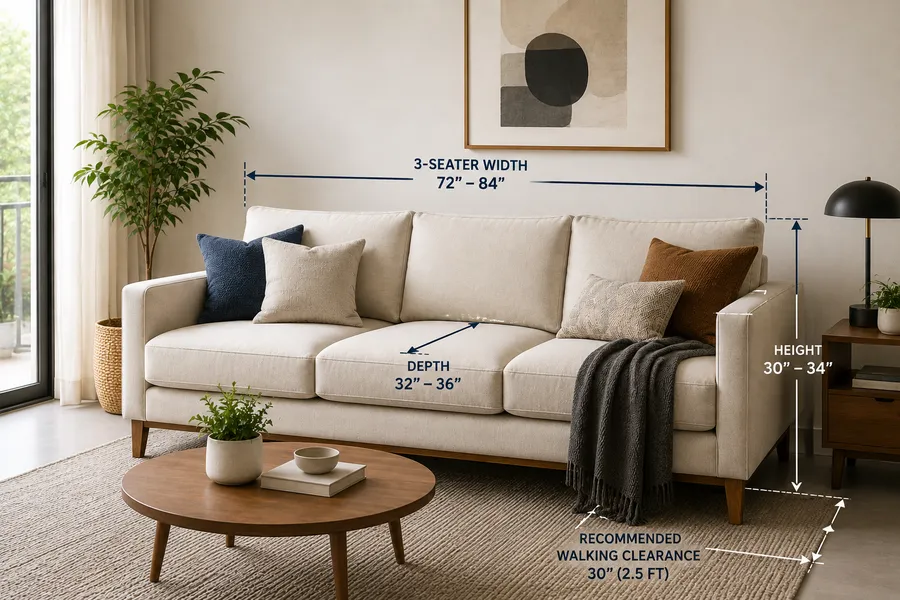
A 3-seater runs 6 to 7 feet wide on paper, but that number means nothing until it meets your actual wall, doorway and walkway. The measurements, conversions, and clearances that decide whether a sofa really fits.
Meera Nair ·
Materials
How to choose a sofa fabric that survives real life
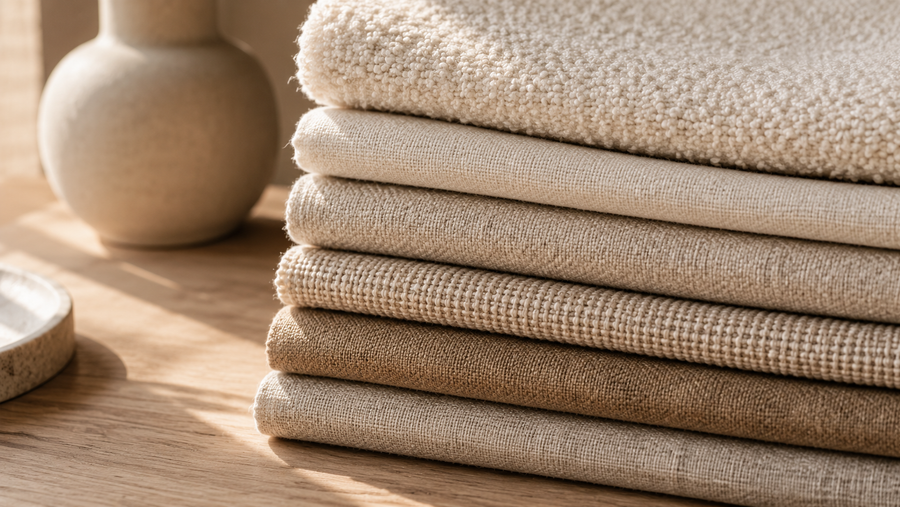
The right sofa fabric balances three things: how it feels, how it looks after two years, and how much care you will honestly give it. Here is how we help clients choose.
Meera Nair ·
Thinking about a custom piece?
We design and craft furniture around your space, style and story.