
7 Types of Dining Tables: Bangalore Homes Should Have
Dining tables come in four shapes — rectangular (4–8 seats), round (2–6 seats, compact spaces), oval (rectangular seating, no hard corners), and square (4 seats, compact homes). Extendable tables add seats for guests; custom-built tables fit rooms standard sizes can't.
Meera Nair · Materials & Finishes Specialist · Published
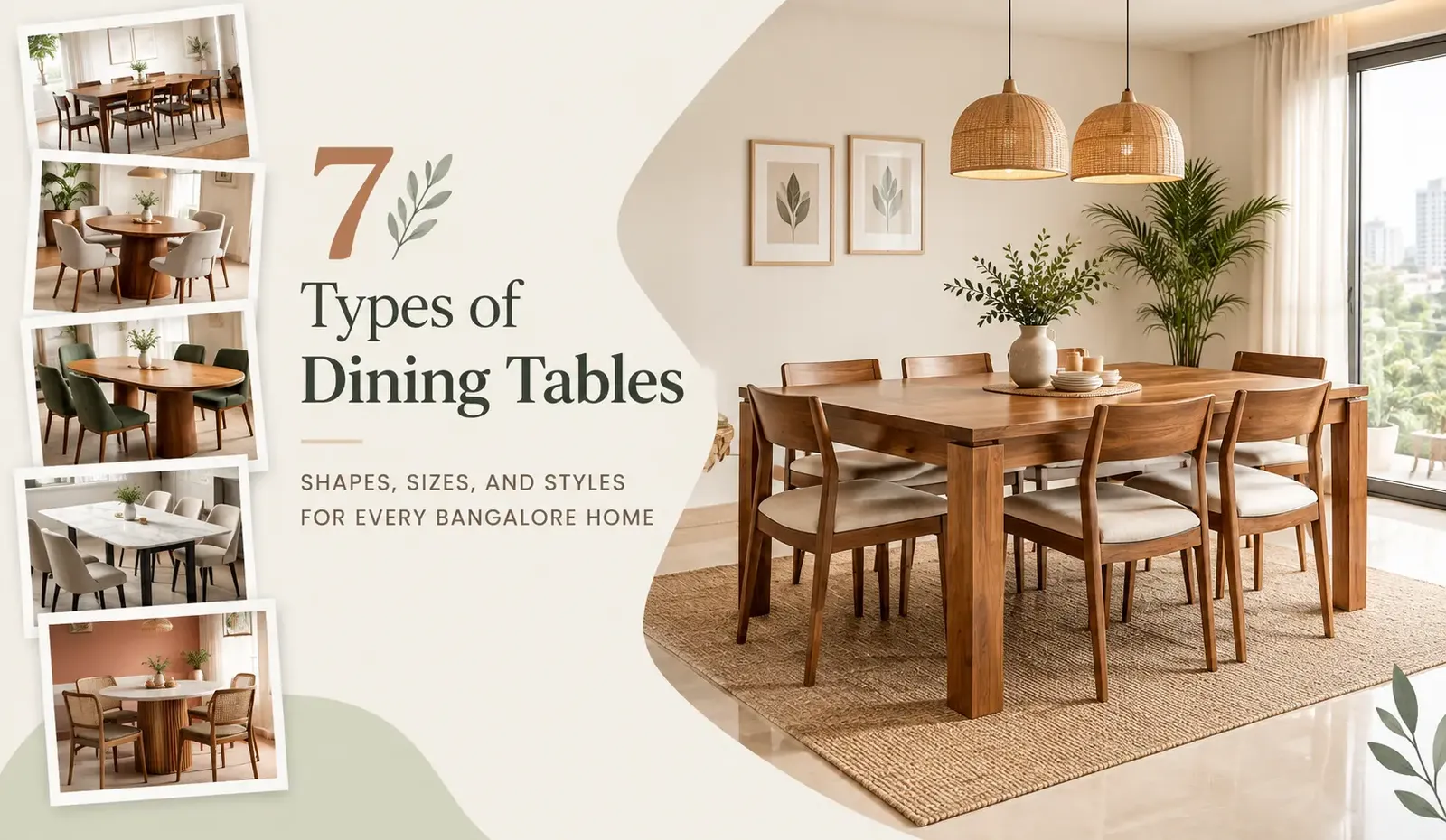
Choosing a dining table isn't really a design decision first — it's a fit decision. The types of dining tables available differ in shape, size, material, and how they handle a room, and the wrong pick shows up fast: chairs that scrape a wall on every pull-out, a table too small for the family that actually sits down each evening, or one so large the room never feels used for anything else. Household size, how often you host, your dining area's dimensions, and whether you're in a compact Bangalore apartment or a larger independent house all shape the right answer — more than style does.
Before comparing types, it helps to know what you're actually solving for:
- How many people eat here on a normal day, versus when guests come over
- The actual floor dimensions of your dining area, not just the room name on the floor plan
- Whether the table needs to fit a fixed alcove, an open-plan layout, or a balcony/breakfast nook
- Budget, and whether solid wood, veneer, or a mixed-material top makes sense for that budget
With that in mind, here are seven dining table types worth knowing before you buy.
What Are the Different Types of Dining Tables?
1. Rectangular dining tables
The default shape for a reason: rectangular tables use floor space efficiently and scale from four seats to ten without looking odd. They work in most room shapes, pair with almost any chair style, and are the easiest to extend.
- Best for: families of 4–8, households that want maximum seating per square foot
- Room size: medium to large dining areas; needs enough length for a clear walking aisle on the open ends
- Seating: comfortably 4, 6, or 8; larger with an extension leaf
- Advantages: efficient use of space, wide chair and material choice, easy to extend
- Limitations: can look bulky in a small or narrow room; corners eat into circulation space if the room is tight
- Materials: solid wood (teak, oak) is common for rectangular tops because the long grain runs cleanly along the length
- Bangalore fit: the standard choice for independent houses and larger apartment dining rooms — most 3BHK dining spaces in the city are proportioned for a rectangular 6-seater
2. Round dining tables
Round tables remove corners, which matters more than it sounds — everyone's roughly equidistant, conversation flows without anyone at "the head," and there's no sharp edge to navigate around in a tight room.
- Best for: couples, small families, anyone prioritising conversation over maximum capacity
- Room size: works especially well in square or compact rooms where a rectangular table would leave awkward corners
- Seating: typically 2–6; beyond that, the tabletop diameter needed starts to overwhelm most Indian dining spaces
- Advantages: softer traffic flow, no corners to bump into, visually opens up a small room
- Limitations: seats fewer people per square foot than a rectangle of similar footprint; less serving space in the centre for large spreads
- Materials: works well with a single pedestal base in wood, keeping legroom open underneath
- Bangalore fit: a strong choice for 2BHK apartments where the "dining area" is really a corner of the living room — a round table reads less like a hard boundary between zones
3. Oval dining tables
Oval is the shape people reach for when a room is narrow, but they still want rectangular-table seating. It keeps the length needed for 6–8 seats while losing the sharp corners that make a rectangular table awkward in a tight walkway.
- Best for: narrow dining areas, households that want round-table softness without sacrificing seating
- Room size: particularly good where a doorway, sideboard,d or kitchen counter cuts close to one end of the table
- Seating: 6–8 comfortably, similar to a rectangular table of the same length
- Advantages: eases circulation past furniture or door swings, seats nearly as many as a rectangle
- Limitations: slightly less usable surface area at the ends compared to a true rectangle
- Materials: solid wood tops on a twin-pedestal base are common, since the curved ends don't suit a four-leg corner base as cleanly
- Bangalore fit: useful in apartments where the dining area sits directly in a walkway between the kitchen and living room
4. Square dining tables
Square tables suit smaller households and tighter footprints. They're compact, sit well against a wall or in a corner, and keep the table from dominating a small room.
- Best for: couples, small families, breakfast-style dining
- Room size: compact apartments, breakfast nooks, smaller independent dining spaces
- Seating: typically 4; larger square tables for 8 exist but need a genuinely large room to avoid feeling like a boardroom table
- Advantages: space-efficient, can be pushed into a corner when not in use, visually tidy
- Limitations: doesn't scale well past 4–6 seats without becoming unwieldy
- Materials: works in most materials; solid wood or wood-veneer tops are common at this size
- Bangalore fit: a practical fit for studio and 1BHK apartments, or as a secondary breakfast table alongside a larger dining setup
5. Extendable dining tables
An extendable table runs compact day-to-day and opens up when guests arrive — everyday size for a family of 4, festival size for 8.
- Best for: households with occasional large gatherings but no daily need for a big table
- Room size: works in small to medium rooms, provided there's floor space nearby for the table to expand into
- Seating: commonly 4–6 seats standard, extending to 8+
- Advantages: flexibility without owning two tables; efficient use of a compact dining area most of the year
- Limitations: extension mechanisms add cost and need occasional maintenance; not every design extends smoothly after years of use, so mechanism quality matters more than it looks
- Materials: solid wood extension leaves should be sourced from matching boards so grain and colour don't visibly mismatch when opened
- Bangalore fit: well suited to apartments that host festivals, birthdays or extended family visits but don't have room for a permanent 8-seater
6. Compact and breakfast tables
Not every home needs a full dining table. Smaller two-to-four seat tables — sometimes bar-height, sometimes standard — work as a dedicated breakfast spot, a balcony dining setup, or the only table a smaller apartment has room for.
- Best for: studio and 1BHK apartments, balconies, secondary casual dining spots
- Room size: small nooks, balconies, corners of an open-plan kitchen
- Seating: 2–4
- Advantages: fits where a full dining table can't; lower cost and footprint
- Limitations: not suitable as the sole table for a hosting-heavy household
- Materials: lighter wood tops or a mix of materials, since the table usually needs to be easy to move
- Bangalore fit: common in compact apartment layouts across the city where the kitchen and dining area share one small zone
7. Custom-built dining tables
This isn't a shape — it's a different starting point. Instead of picking the closest match from a fixed range of sizes, a custom table is designed to your room's exact dimensions, seating needs, and material preferences from the start.
- Best for: irregular dining areas, specific seating counts that don't match standard sizes, households that have tried "close enough" before and found it wasn't
- Room size: any — that's the point
- Seating: built to the number you actually need, not the nearest standard option
- Advantages: no compromise on fit, full control over wood, finish, base design and edge profile
- Limitations: longer lead time than buying off a shelf; typically a higher starting cost than a mass-produced equivalent
- Materials: whatever solid wood species suits the brief and budget
- Bangalore fit: particularly relevant in the city's apartment layouts, where dining areas are often oddly proportioned — too narrow for a standard 6-seater, or with a support pillar exactly where a table leg would normally go
Which Dining Table Shape Is Best for a Small or Large Room?
Factor | Rectangular | Square | Round | Oval |
Space requirement | Moderate–high | Low | Moderate | Moderate–high |
Seating capacity | High (4–8+) | Low–moderate (4–6) | Low–moderate (2–6) | High (6–8) |
Best room shape | Rectangular room | Square/compact room | Square room | Narrow or transitional room |
Small apartment suitability | Fair | Good | Good | Fair |
Large family suitability | Excellent | Poor | Fair | Good |
Conversation | Good at 6 or fewer | Good | Excellent | Good |
Movement around table | Needs clear aisle on open ends | Easy to navigate | Easiest — no corners | Easier than rectangular |
Hosting guests | Excellent, especially with extension | Limited | Limited past 6 | Good |
No single shape is correct for every room — match it to your dining area's actual proportions and how many people you seat on a normal day versus a festival day.
What Size Dining Table Do You Need for 4, 6 or 8 Seats?
A rough industry standard is about 60cm of table edge per person, which is why seating counts map fairly consistently to table length:
Seats | Typical length |
4-seater | 120–150 cm |
6-seater | 160–180 cm |
8-seater | 210–240 cm |
Seating capacity alone doesn't decide whether a table fits your room, though. Chair clearance (leave roughly 90cm behind each seated chair so someone can pull out and stand comfortably), nearby doorways, and other furniture in the walkway matter just as much as the table's footprint. A table that's technically the "right" size for four people can still feel cramped if it's wedged against a sideboard with no room to pull a chair back.
For a fuller walkthrough of measuring your specific dining area, see our dining table size guide.
What Types of Wood Are Used for Dining Tables?
Material affects everything from day-to-day maintenance to how the table ages over ten or twenty years. Common options in the Indian market:
- Teak — naturally moisture- and pest-resistant, ages to a warm golden-brown, among the more stable solid woods in humid climates
- Sheesham (Indian rosewood) — strong grain patterns, dense and durable, widely used in traditional and transitional Indian furniture
- Mango wood — a more budget-friendly solid wood option, reasonably durable but generally softer than teak or sheesham
- Oak and ash — lighter tones with visible grain, popular in contemporary interiors
- Walnut — deeper, richer tone often chosen for formal dining spaces
- Engineered wood/veneer — more dimensionally stable in fluctuating humidity, generally more affordable, but doesn't sand and refinish as many times as solid wood over its lifespan.
There's no universal "best" wood — it depends on your budget, how much natural grain variation you want visible, how much maintenance you're willing to do, and how the room's humidity and sunlight exposure behave through the year. Bangalore's relatively moderate, less extreme humidity swings compared to coastal cities make most solid woods a workable choice, though direct sun exposure and proximity to a kitchen's steam still matter for finish choice.
If you're weighing solid wood against engineered options in more depth, see our solid wood vs engineered wood comparison.
How Do Extendable Dining Tables Work?
An extendable table adds seating capacity through one of a few common mechanisms:
- Butterfly leaf — a hinged centre leaf folds and stores within the table itself, unfolding when the table is pulled apart
- Drop-leaf — hinged leaf panels on the sides or ends fold down when not needed
- Pull-out / slide leaf — the tabletop separates and a stored leaf slides into the gap
Who benefits: households in compact apartments who host occasionally but don't want a permanently oversized table taking up floor space year-round.
Advantages: one table serves two purposes; efficient for smaller Bangalore dining areas that need to earn their square footage most of the year.
Limitations: mechanisms add moving parts, which means quality matters — a well-built extension should still glide smoothly after years of use. Extension leaves also need to be sourced from matching timber so the join doesn't stand out once opened.
Before buying, check: how easily one person can operate the mechanism, whether the leaf storage adds noticeable bulk to the base, and whether the extended grain and finish genuinely match the main top.
How Do You Match Dining Table Height to Dining Chairs?
A table sized correctly for a room can still feel wrong if the chairs don't work with it. A few standard proportions to check:
- Table height: typically around 75cm
- Chair seat height: typically around 45cm
- Clearance: aim for roughly 25–30cm between the seat and the underside of the tabletop for comfortable knee room
- Chair width and spacing: allow roughly 60cm of width per chair so elbows don't collide during a meal
- Legroom: table bases with legs at the corners reduce usable knee space compared to pedestal or trestle bases — worth checking if you're seating people at the ends
Material and colour coordination between table and chairs matters visually, but comfort measurements matter more for daily use — a beautiful chair that doesn't clear the table properly gets used less over time.
Which Dining Table Type Suits a Bangalore Apartment?
If you live in a compact apartment: a round, square, or compact breakfast-style table uses limited floor space better than a large rectangle.
If your family has 4 people: a square or smaller rectangular table (120–150cm) covers daily needs without excess.
If your family has 6 people: a rectangular or oval table in the 160–180cm range is the standard fit.
If you regularly host guests: an extendable table, or a rectangular table sized generously from the start, avoids the cramped-seating problem on the days it matters most.
If your dining area is narrow: an oval table eases circulation better than a rectangular table with hard corners in the same footprint.
If you want flexible seating: an extendable table is the practical answer over buying two separate tables.
If you want a statement dining area: a solid wood table with a distinctive base — pedestal, trestle, or a live edge profile — does more visual work than shape alone.
If your dining space has unusual dimensions: a pillar in the wrong place, a sharply angled wall, or a non-standard room shape is where a custom-built table earns its cost — standard sizes simply won't solve an irregular room.
Ready-Made or Custom Dining Table — Which Should You Buy?
Ready-made dining tables are faster to get and typically less expensive upfront, and for a fairly standard room shape and seating count, they're often the sensible choice — there's no need to pay for customisation a standard size already solves.
Custom tables make more sense when:
- Your room's dimensions don't match a standard size cleanly
- You want a specific wood species, finish, or seating count outside the common options
- Chair pull-out clearance or a door swing conflicts with a standard table footprint
- You want a base design (pedestal, trestle, edge profile) that isn't commonly stocked
Custom furniture isn't a strictly "better" option — it's a different trade-off: longer lead time and typically higher cost, in exchange for a table designed around your specific space rather than the other way around.
All About Furniture is a custom furniture studio in Bangalore building dining tables to order in solid wood, with size, shape, wood, and finish chosen for the room rather than picked from a fixed range. If your dining area is one of the trickier shapes to furnish, that's the scenario custom is built for.
Frequently asked questions
What are the main types of dining tables?
The most common types are defined by shape — rectangular, square, round,d and oval — along with functional variations like extendable and compact breakfast tables. Custom-built tables are a separate category defined by process rather than shape, designed for a specific room instead of a standard size.
What size dining table do I need for a family of 4?
A table in the 120–150cm range typically seats 4 comfortably, though the right size also depends on your room's clearance for chairs and walking space.
Which wood is best for a dining table?
There's no single "best" wood — teak and sheesham are popular for durability and grain character, oak and walnut suit lighter or more formal interiors, and mango wood is a common budget-friendly solid wood option. The right choice depends on budget, maintenance tolerance, and the room's light and humidity exposure.
Are extendable dining tables worth it for small apartments?
Often yes, if you host occasionally but don't have room for a permanently large table. The trade-off is a slightly higher cost and a mechanism that needs decent build quality to stay smooth over years of use.
Should I choose a round or rectangular dining table for a small Bangalore apartment?
Round tables generally work better in compact or square rooms because they remove hard corners from the walkway. Rectangular tables fit better in longer rooms and seat more people per square foot.
When does a custom dining table make more sense than a ready-made one?
When your room's dimensions, seating needs, or layout constraints (like a pillar or tight walkway) don't match standard sizes, a table built to the room's exact measurements avoids the compromises a standard size forces.
Tags:Dining tables
Keep reading
Guides
Dining table size guide: fitting the table to the room (and the family)
Sixty centimetres per person, ninety for the walkway, and a shape chosen by the room: the arithmetic behind a dining table that actually works.
Hemanth Kumar ·
Materials
Solid wood vs engineered wood: what actually matters
Neither material is “better.” They solve different problems. Where solid wood earns its price, where engineered boards genuinely win, and how we combine them.
Meera Nair ·
Thinking about a custom piece?
We design and craft furniture around your space, style and story.
Start Customizing